按照我们对哈特论证的一般理解,哈特首先按照奥斯丁的主权者命令说(the prescription of the theory of sovereignty)构想了一个简单的雷克斯法律世界(CL, 54)。然后哈特又指出,这个只有服从习惯的法律世界无法确保法律的连续性(continuity),除非引入某些规则,比如关于王位继承的规则,而连续性是我们熟知的任何法律体系的特性。最后,哈特指出,社会单纯拥有一种习惯和拥有一项规则的差别在哪里。
他设想有一群人长期生活在由专制君主雷克斯统治的领土(there is a population living in a territory in which an absolute monarch (Rex) reigns for a very long time),雷克斯以威胁为后盾的命令来管理他的臣民。
在这之后,哈特又说,“明显,我们刚才描述的那个社会,是一个非常简单的社会,是为了能够尽可能在字面上使用服从习惯的概念(the notion of a habit of obedience)”(CL, 53),然后他又说,这样一个社会因为过于简单可能“从未在任何地方存在过”(CL, 53),它也不是一个原始社会,因为原始社会中不会有雷克斯这样的专制统治者。(CL, 53)
我们上面的讨论已经足以表明这一点。没有任何概括性观念,我们自己甚至不能思想,何况一个社会服从的产生?何况描述一个被称之为法律世界的社会服从世界?既然认为“服从”哪怕从字面讲也包含了规则要素,怎么又能设想一个“字面上”应用这个词的无规则的情形?这是逻辑上的自相矛盾。就好比你已经知道,逻辑上不可能有 a 这个前提,但你还是假设若一个推理有这样一个前。然后你做的事情,当然,是推翻它能够是前提的假设,但这有什么意义?这不是归谬法。
再次,奥斯丁甚至还提到“国王得永生”(the king never die)的英国谚语。他说:“关于这一宪法的一句格言,可以说明这一段落的主题。这句格言是:‘国王得永生’(the king never die)。我相信,其含义是可以这样来解释的:尽管王位上的端坐者。是具体的个人,终有一日离开人间,其生命是短暂的。但是,王位本身的延续,是不可能中断的。……当一名真实的国王去世的时候,王位可以立即传给符合国王一般特征的要求的具体个人,这个人,有资格戴上皇冠。”根据《王位继承法》所描述的国王的一般特征,这名具体的个人,是皇冠的继承者。(p188-189)他在许多地方明确指出,主权者、国王、皇帝等等无论什么统治者的称呼表达的是一个资格、政治位置,是具有特定特征的人,而不是任何具体的个人。“乔治成为英国的国王,以及爱尔兰的国王,成为最高主权机构的特定的实体的一名成员,不是因为他是具体的乔治,而是因为他是一个符合国王的一般特性的个人”(p187),“最高统治实体中的成员,是根据一般的和固定的资格,来掌握最高统治地位的”(p194-5)。
现在我们来到哈特关于社会习惯和社会规则(一种特殊实践)的社会现象类型区。他的错误隐藏很深,他要说明的是一个社会“拥有一项规则”(have a rule)意味着对“接受规则”(rules-acceptance)的反思批判态度,但他在雷克斯设想情形中对比论证的是,无规则的社会现象和有规则的社会现象。因此哈特的错误有两个不同层次:他的第一层错误在于:认为有无规则的社会现象和有规则的社会现象这两类社会现象;他的第二层错误在于:认为有对规则没有内在观点的社会现象和对规则有内在观点的社会现象这两类社会现象。第一层中的前者都叫习惯,第二层次的前者都叫社会规则(实践)(他在这一点上是模糊的,他只是对照的是“习惯”和“拥有规则的实践”,但他也在实践的意义上使用“社会规则”,因此我们不能说哈特拒绝习惯是一种实践。)。
我想起了弗兰斯·德·瓦尔(Frans de Waal)著名的动物实验。两只猴子关在相邻笼子里。如果都给黄瓜,它们很高兴(绝对平等,虽然贫乏)。如果一只给黄瓜,另一只给葡萄(葡萄更好吃),那只拿黄瓜的猴子会哪怕饿肚子也要把黄瓜扔回实验员脸上,并剧烈摇晃笼子表示抗议。猴子不懂罗尔斯的“差异原则”(它没有想“虽然我有黄瓜,但如果我不抗议,也许以后葡萄也会分我一点”)。 猴子只有一个直觉:不公平(Inequity)本身就是一种伤害。这种“不患寡而患不均”的本能,是写入灵长类基因里的。可以想象的占据优势地位者的亏欠感也有进化意义:如果这些人对不平等无动于衷,要么不能及时发现不利地位者的怨恨,要么倾向于扩大自己的优势地位,这两者都可能更快地摧毁社会。 ↩︎
The gap between Europe's self-image and reality has grown into a chasm of delulu. One that's threatening to swallow the continent's future whole, as dangerous dependencies on others for energy, security, software, and manufacturing stack up to strangle Europe's sovereignty. But its current political class continues to double down on everything that hasn't worked for the past forty years.
But you can see why many politicians in Europe are eager to punish X for giving Europeans a social media that doesn't cooperate with its crackdown on wrongthink. The German chancellor, Friedrich Merz, is personally responsible for 5,000(!!) cases pursuing his subjects for insults online, which has led to house raids for utterances as banal as calling him a "filthy drunk".
It's against this backdrop — thousands of yearly arrests for banal insults or crass opposition to government policies — that some Europeans still try to convince themselves they're the true champions of free speech and freedom of the press. Delulu indeed.
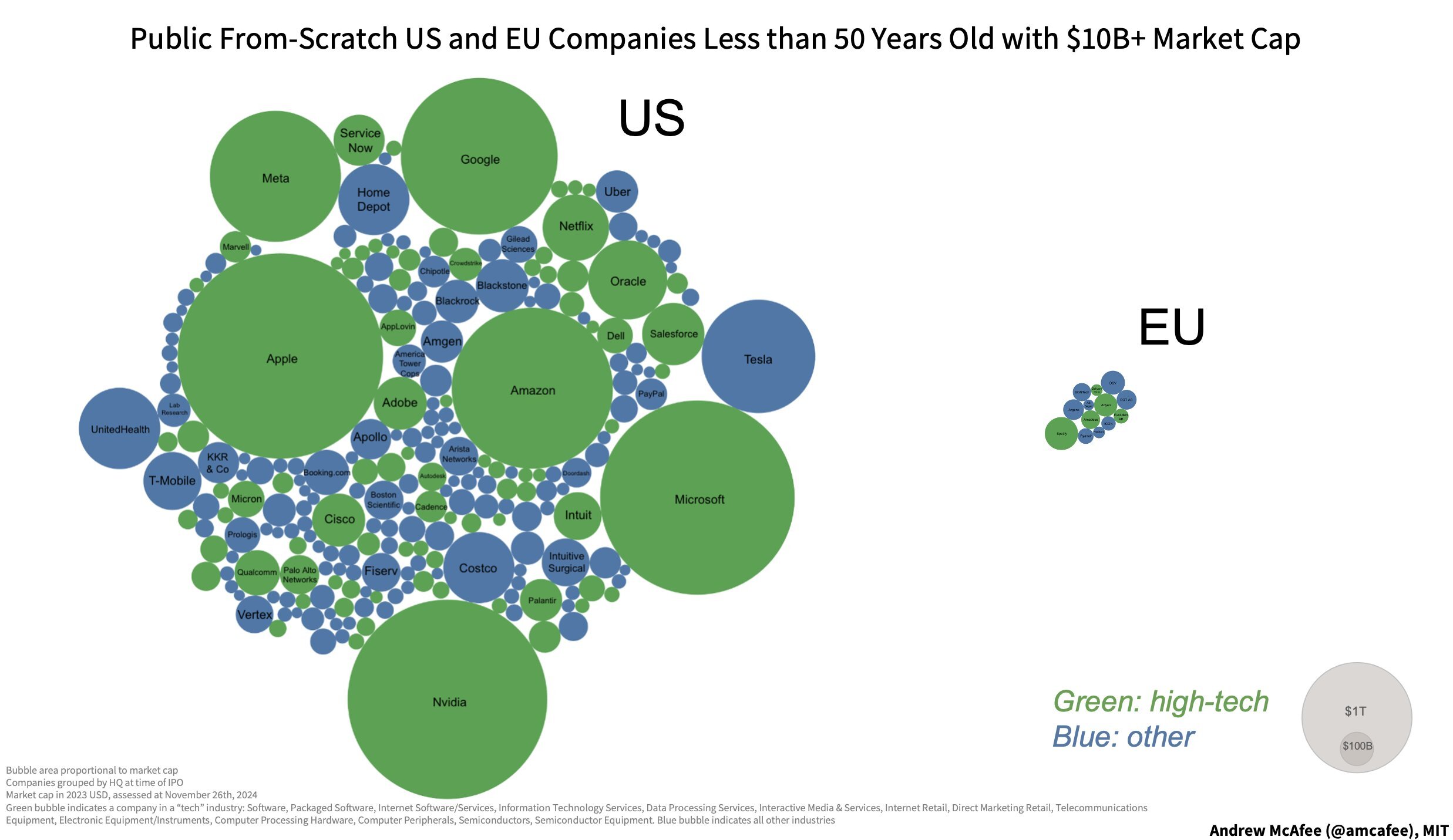
That's primarily because Europe basically stopped creating new, large companies more than half a century ago. So as the likes of Nokia died off, there was nobody new to replace them. In the last fifty years, the number and size of new European companies worth $10 billion or more is alarmingly small:
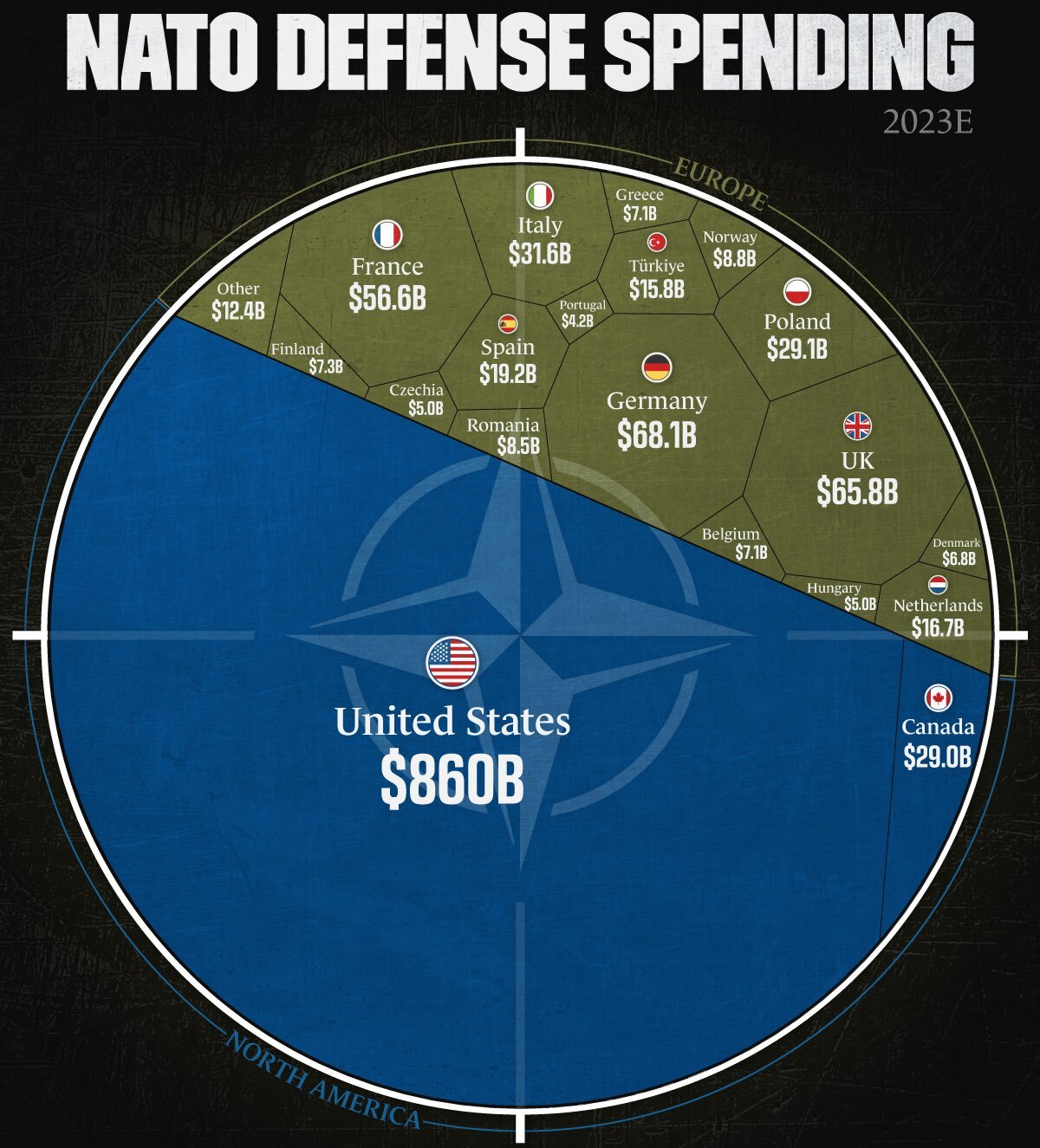
So cue the talk about security. European leaders are incensed by getting excluded from the discussion about ending the war in Ukraine, which is currently just happening between America and Russia directly. But they only have themselves to thank for a seat on the sidelines. Here's a breakdown of the NATO spending by country:
This used to be a joke to Europeans. That America would spend so much on its military might. Since the invasion of Ukraine, there's been a lot less laughing, and now the new official NATO target for member states is to spend 5% of GDP on defense.
But even this target fails to acknowledge the fact that even if European countries should meet their new obligations (and currently only Poland among the larger EU countries is even close), they'd still lag far behind America, simply because the EU is comparatively a much smaller and shrinking economic zone.
In 2025, the combined GDP for the European Union was $20 trillion. America was fifty percent larger with a GDP of $30 trillion. And the gap continues to widen, as EU growth is pegged at around 1% in 2024 compared to almost 3% for the US.
Now this is usually when the euro cope begins to screech the loudest. Trying every which way to explain that actually Europe is a better place to live than America, despite having a GDP per capita that's almost half.
And on a subjective level, that might well be true! There are plenty of reasons to prefer living in Europe, but that doesn't offset the fact that America is simply a vastly richer country, and that matters when it comes to everything from commercial dominance to military power.
But it's the trajectory that's most damning. In 2008, Europe was on near-parity in GDP with America! But if the 1% vs 3% growth-rate disparity continues for another decade, America will grow its economy by another third to $40 trillion, while Europe will grow just 10% to $22 trillion. Making the American economy nearly twice as large as the European one. Yikes.
These should all be sobering numbers to any European. Whether it's the 10,000 yearly arrests in the UK for social media posts or the risk of an economy that's half the size of the American one in a decade.
But Europe isn't doomed to fulfill this tragic destiny. It's full of some of the most creative, capable, and ambitious people in the world (like the fifth of US startup unicorns with European founders!). But they need much better reasons to stay than what the EU (and now a separate UK) is currently giving them.
Like drastically lower energy costs to for a competitive industrial base and to power the AI revolution, so best we quickly revive European nuclear ambitions. Like an immigration policy designed to rival America's cherry-picking of the world's best, rather than mass immigration from low-average-IQ regions of net-negative contributors to the economy (and society). Like dropping the censorship ambitions and bureaucratic boondoggles like the DSA. Like actually offering a European internal market for remote labor and a unified stock exchange for listings.
There are plenty of paths to take that do not end in a low-growth, censorious regime that continues to export many of its best brains to America and elsewhere. So: make haste, the shadows lengthen.
后来想再「认认真真」去一次 Shelter 的时候,它就关门了。人们在这个区域找回属于自己最原始的、不需要活在面具之下的身份。而与之相对,是一个类似的空间,人们在里面都戴着面具而活,那就是上海的 Sleep No More 的傻逼话剧(抱歉我用了相对侮辱的词汇),一群人都觉得自己看懂了胡乱的剧情演绎,像是集中营的昏暗空间里,都在暗自比较自己比他人更理解故事与情感,这一部分下次来说。
# LostOfShelter
符号、文艺和高概念
简单介绍一下 Sleep No More 的模式。
不眠之夜(英语:Sleep No More)是剧场公司 Punchdrunk 所创作的沉浸式戏剧,其内容根据威廉·莎士比亚《麦克白》、黑色电影以及佩斯利女巫等故事情节改编而来。2011 年 3 月 7 日,不眠之夜在美国纽约首演。
因为我们共同使用 Gemini 的缘故,我有机会看到他在 Gemini 上的对话(他那边也有我的账户)。我就随手翻了下,我发现他最近让 Gemini 帮他修改审阅一篇大概五年前的论文。这篇论文当时给我看过。此外他还问过 Gemini 康德如何区分优美感和崇高感,诸如此类。问题不多,不似我这样一步步启发式地与 AI 聊天,把 AI 当做一个可以激发灵感的对话伙伴(谁让我没有真人对话伙伴呢)。他几乎只是致力于弄懂康德哲学的某些部分。
我仔细思考了我和他的不同:
(1)在研究对象方面,我研究的是问题,我想弄清楚,比如说 A 到底是不是 B;他研究的是信念,他想弄清楚,比如说,x 是不是认为 A 是 B。
(2)在研究旨趣方面,我的研究可能牵涉到康德,比如说康德到底是否认为 C 是 D。我可能会去研究这个问题,但最终会回到自己的问题。我的研究旨趣不在于弄清楚任何人的确想什么,而是我的确想什么。与我不同,当我将所牵涉的问题与他交流,他会立即为这个问题在康德研究中寻找一个定位:如果有,则他可能会感兴趣,并且只是投入对康德如何理解这个问题的问题研究当中,而且不会返回到直面问题的情形中;如果没有,则判断不是一个真正/专业的关于康德的问题。